GRAD-C6-2001: Statistics II — Replication Paper
A reassessment of the labor market competition hypothesis: investigating attitudes towards immigration
08.06.2021
Chapter 1 Fact sheet
Core topic:Jeannet (2018) empirically assesses the widespread notion, that the negative predisposition towards immigration is a result of labor market competition. Furthermore, the study challenges the ergo-tropic motivation of attitudes towards immigration implied by the labor market competition hypothesis and argues for a more socio-tropic explanation pattern.
Data:
The study is based on the European Social Survey (2014, hereinafter ESS) from 2014 (round 7), which is cross-national1 and queries attitudes of respondents, inter alia, about immigration. The ESS selects participants with random-probability methods and face-to-face interviews were conducted. The data consists of 3.616 obervations after Jeannet (2018, 2) applied the following criteria:
- Only men who are between 50 and 69 years old, and
- excluding those, who have never worked or have not worked after 50.
To bypass the challenge of finding the exogenous variation in the attitude towards immigration in the literature (and therefore accounting for factors such as socialization, religious beliefs, and values, which influence attitudes towards immigration as well), Jeannet (2018) uses an instrumental variable design.
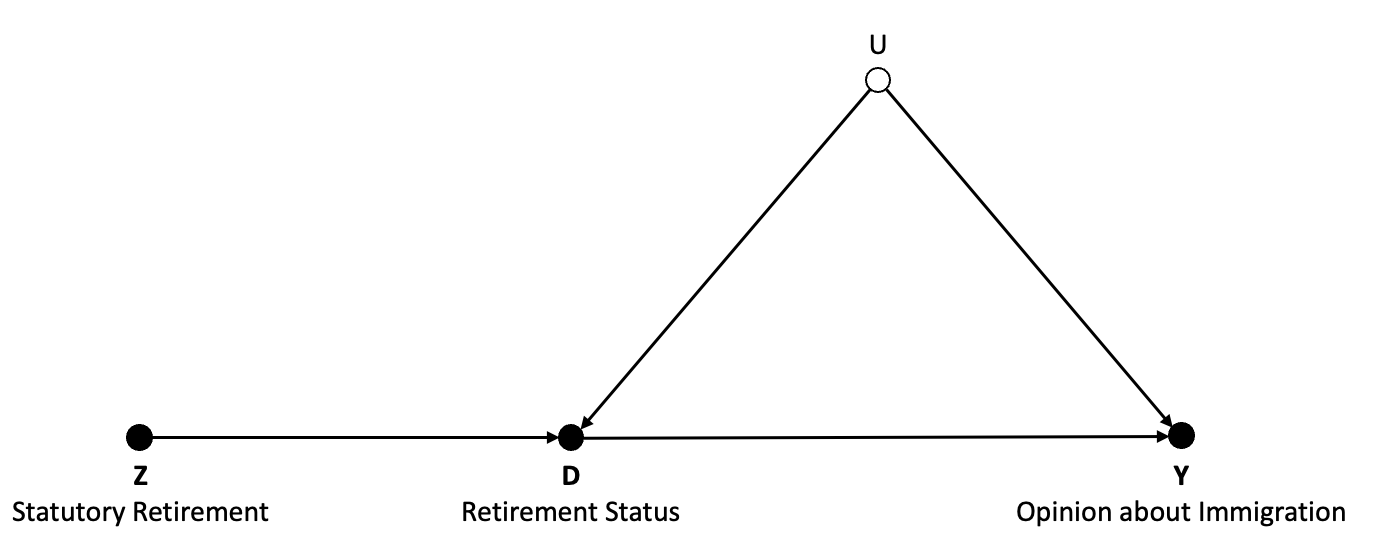
Figure 1.1: Directed Acyclical Graph for the setup of the model by Jeannet (2018)
She exploits “cross-country variation in early and full retirement ages as an instrument for a person’s retirement status” (Jeannet 2018, 2). To ensure exogeneity and thereby fulfilling the assumption of ignorability of instrument, she uses full statutory retirement ages in all 14 countries as an as-if random assignment to treatment. The exclusion restriction holds, because statutory retirement most likely only affects the outcome variable attitudes towards immigration via the treatment of the model, retirement behavior. The cross-national setup allows to account for any variations around the threshold of the retirement age in the respective countries, which is not the case. To meet the requirements of the relevance assumption, (Jeannet 2018, 3) accounts for the predictive strength of the instrumental variable with significant coefficients for early retirement and full retirement statutory ages for a person’s propensity to retire.
I add two moderation models to account for potential differences of the effect for countries which implemented austerity measures recently and different levels of exposure to ethnic minorities. This strategy provides a more nuanced perspective of the effect.
- The retirement status does not substantially shift the opinion about immigration and therefore negative predisposition towards immigration is empirically, in this model, not a result of labor market competition.
- In fact, individuals continue to have the same opinion about immigration after their retirement and hence factors such as values or political believes are more likely to be drivers of the attitude towards immigration. However, it remains a challenge to observe such often unobserved factors.
- Also by considering the effects of austerity on the labor market by moderating the effect by country, no substantial association between the retirement status and the attitude towards immigration can be proven.
- The effect identified by Jeannet (2018) is also robust to the moderation by exposure to ethnic minorities.
Only 14 Western European countries are included: Austria, Belgium, Denmark, Finland, France, Germany, Ireland, Netherlands, Portugal, Spain, Sweden, UK, Norway, Switzerland.↩︎