Chapter 2 Replication
2.1 Assessing the validity of the instrument
Before the relationship between being retired and the attitude towards immigration can be statistically assessed, the validity of the instrument needs to be ensured. Firstly, Figure 2.1 provides a visual assessment of this very question. The red vertical line indicates the full retirement age in the respective country. The exclusion restriction seems to hold, as there is no substantial shift in attitudes towards immigration right after the full retirement age. This supports the suitability of the instrument, as the figure implies no association between the instrument, statutory retirement ages, and the outcome of interest, the attitude towards immigration.
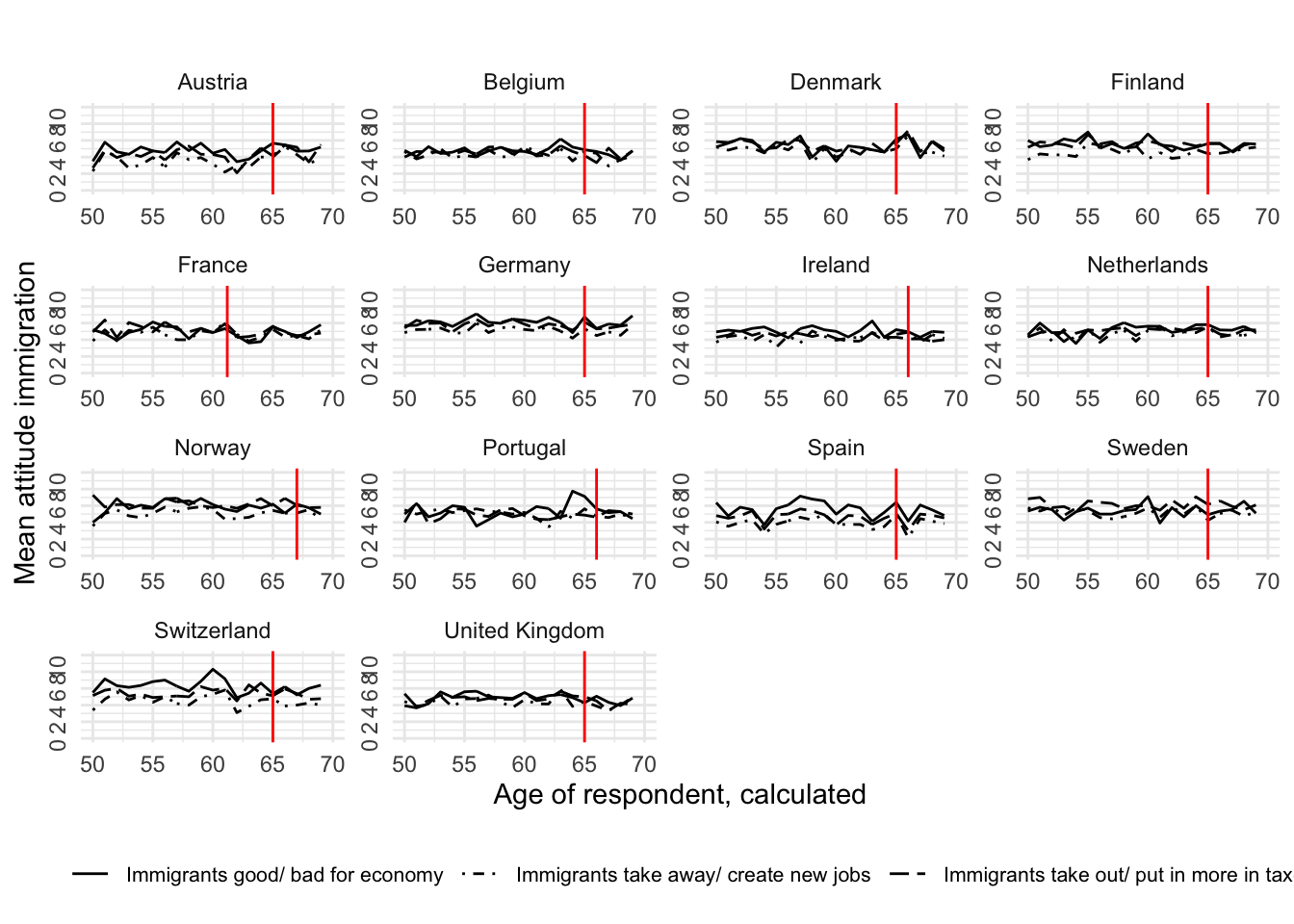
Figure 2.1: Average attitudes towards immmigration and age across 14 western European countries
The graphic below depicts the retirement rates for those who are below or above the early and full retirement age.
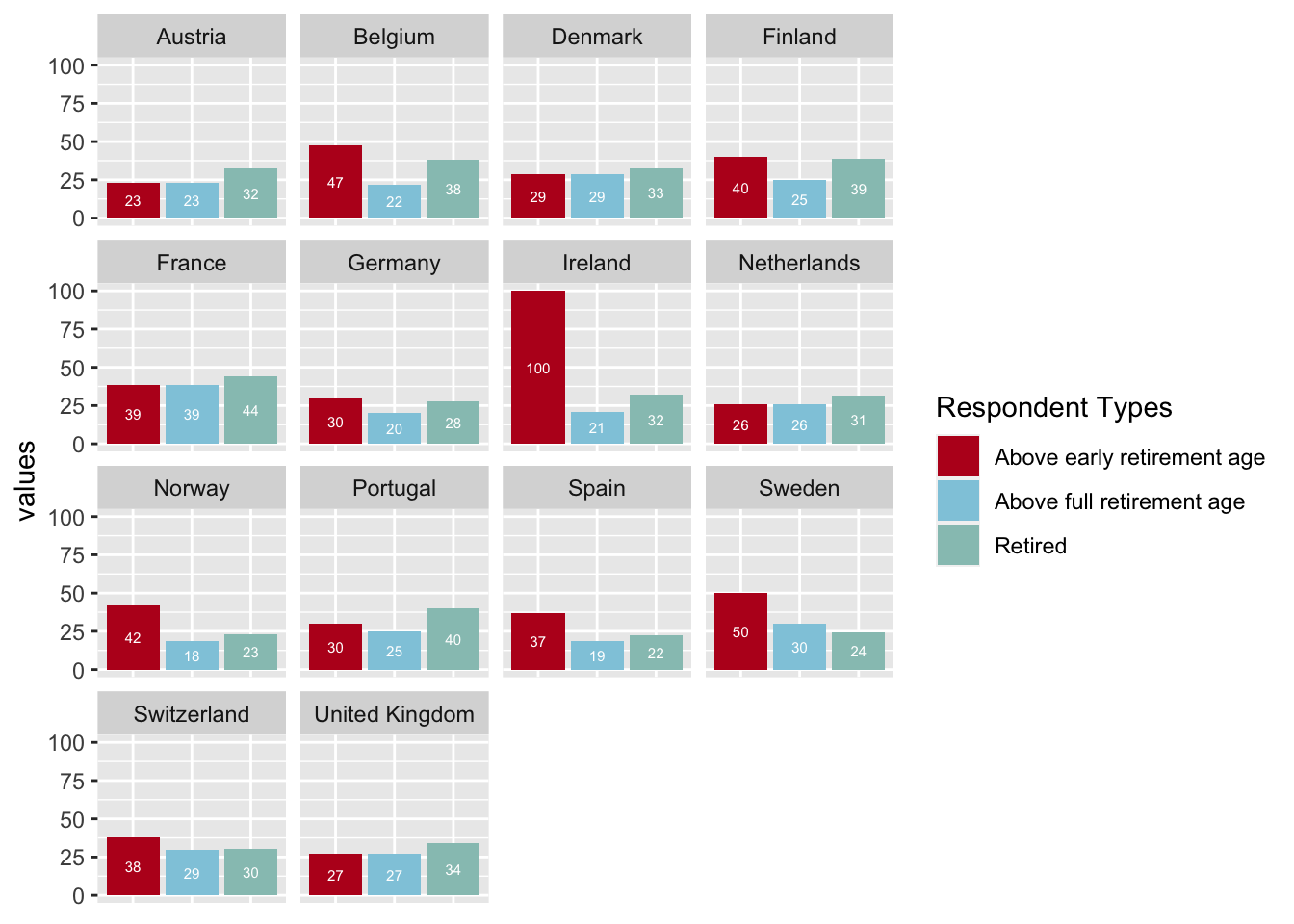
Figure 2.2: Retirement rates of sample by country
To test the relevance assumption of an instrumental variable setup, the table below contains an OLS regression, that assesses the association between the instrument, the full and early retirement ages, and the propensity to be retired. As stated by Jeannet (2018, 3) “[…] early retirement and full retirement ages are significant predictors of retirement behaviors” in the given sample. Furthermore, the table includes a set of covariates.
| Ordinary Least Squares | ||
|---|---|---|
| Outcome Variable: Being retired | Coefficient | Standard Error |
| Above Early | 0.136 *** | 0.028 |
| Above Full | 0.187 *** | 0.034 |
| Age | -0.177 *** | 0.027 |
| Age-Squared | 0.002 *** | 0.000 |
| Education | -0.003 * | 0.002 |
| Income | -0.011 *** | 0.003 |
| Children | 0.001 | 0.014 |
| Left-Right | 0.001 | 0.002 |
| Born abroad | -0.066 *** | 0.017 |
| Married | 0.035 ** | 0.011 |
| Rural | 0.026 * | 0.011 |
| Observations | 3655 | |
| R2 / R2 adjusted | 0.573 / 0.569 | |
|
||
2.2 Effect of Retirement on opinion towards immigration
After assessing the suitablity and validity of the instrument in the previous section, we now examine the relationship between being retired and the attitude towards immigration, whereas only the truly exogenous variation of the treatment in the outcome is considered. Therefore, the portion of the treatment is identified, that is unrelated to confounders and thereby enables to assess the causal relationship without the influence of unobserved confounders.Table 4 includes the coefficients for the OLS as well as the instrumental variable (IV) models for the three different outcomes. Based on this output, the effects can be interpreted. Being retired, on average:
- decreases the perception that immigration is beneficial to the economy by .6.
- decreases the perception that immigration creates jobs by .35.
- decreases the perception that immigration contributes to more taxes by .35.
However, none of the coefficients are significant across all three outcome variables and therefore retiring from the labor market has no significant association with the attitude towards immigration.Therefore, as a preliminary result based on the replication of the analysis by Jeannet (2018), the hypothesis that labor market competition determines the negative attitudes towards immigration cannot be confirmed. To further assess the validity of this result and deepen the understand of what does determine the attitude towards immigration, the next paragraph replicates the survey experiment by Jeannet (2018).
| OLS (Economy) | IV (Economy) | OLS (Jobs) |
IV (Jobs) |
OLS (Taxes & services) |
IV (Taxes & services) |
|
|---|---|---|---|---|---|---|
| Retired |
-0.086 (0.121) |
-0.605 (0.641) |
-0.012 (0.115) |
-0.350 (0.632) |
-0.022 (0.117) |
-0.350 (0.642) |
| Age |
0.310 * (0.154) |
0.114 (0.283) |
0.131 (0.143) |
0.004 (0.275) |
0.192 (0.149) |
0.069 (0.281) |
| Age-Squared |
-0.002 (0.001) |
-0.001 (0.003) |
-0.001 (0.001) |
0.000 (0.003) |
-0.002 (0.001) |
-0.000 (0.003) |
| Education |
0.074 *** (0.011) |
0.073 *** (0.012) |
0.050 *** (0.010) |
0.049 *** (0.011) |
0.042 *** (0.011) |
0.041 *** (0.011) |
| Income |
0.072 *** (0.018) |
0.066 *** (0.020) |
0.037 * (0.017) |
0.033 (0.018) |
0.033 (0.017) |
0.030 (0.019) |
| Children |
-0.078 (0.100) |
-0.078 (0.100) |
0.015 (0.096) |
0.015 (0.096) |
-0.224 * (0.099) |
-0.223 * (0.099) |
| Left-Right |
-0.135 *** (0.020) |
-0.134 *** (0.020) |
-0.038 * (0.018) |
-0.038 * (0.018) |
-0.147 *** (0.019) |
-0.147 *** (0.019) |
| Born abroad |
0.674 *** (0.151) |
0.641 *** (0.158) |
0.602 *** (0.141) |
0.580 *** (0.148) |
0.785 *** (0.143) |
0.764 *** (0.149) |
| Married |
-0.037 (0.085) |
-0.020 (0.088) |
-0.036 (0.080) |
-0.025 (0.083) |
0.106 (0.085) |
0.118 (0.088) |
| Rural |
-0.159 * (0.077) |
-0.146 (0.079) |
-0.128 (0.074) |
-0.120 (0.075) |
0.018 (0.074) |
0.026 (0.076) |
| Observations | 3616 | 3616 | 3607 | 3607 | 3598 | 3598 |
| R2 / R2 adjusted | 0.162 / 0.155 | 0.158 / 0.150 | 0.128 / 0.120 | 0.125 / 0.118 | 0.098 / 0.090 | 0.096 / 0.088 |
|
||||||
2.3 Survey experiment
As the previous analysis showed, that the widely used ergo-tropic reasoning for the attitudes towards immigration is not statistically significant for the given sample, Jeannet (2018) assesses the socio-tropic reasons that potentially explain the attitude towards immigration. To clarify this vague formulation, we can explain the reasoning as follows: the first part of the paper examines, whether labor market competition and therefore selfish motives can explain the attitude towards immigration by using statutory retirement ages as an instrumental variable. The second part, after neglecting the selfish motives, investigates whether attitudes towards migration are rooted in more general views on the economy and society as a whole and not the individual situation in the labor market.
Methodologically, Jeannet (2018) uses a between-subjects survey experiment, which is part of the European Social Survey (2014) study. A sub-sample of the entire sample used in the first part of the analysis answered a question “which varied the economic status of the immigrants and then asked them to give their immigration policy preferences in a split ballot design” (2018, 5). “Professionals” and “unskilled workers” were used as economic status.
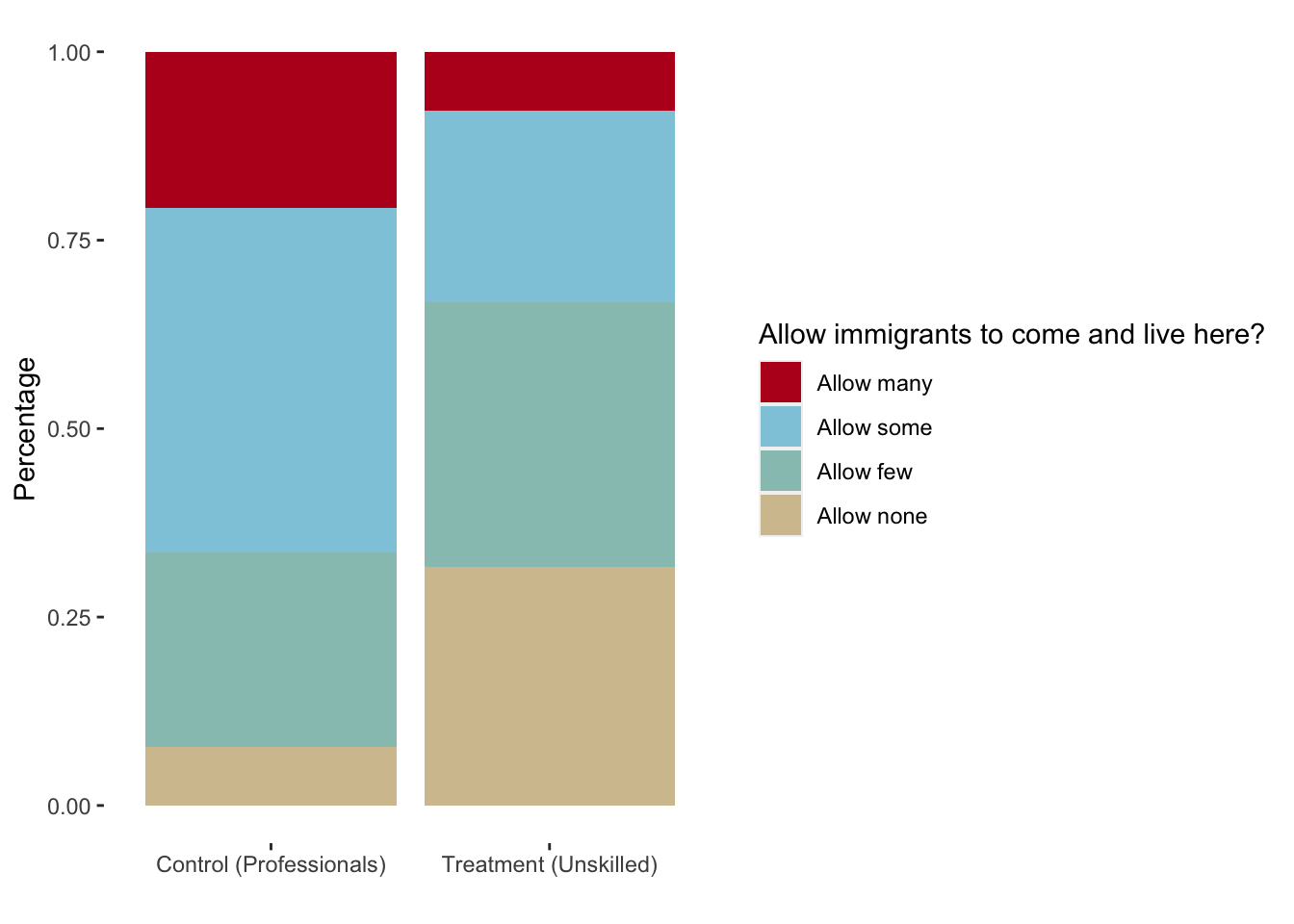
Figure 2.3: Attitudes towards allowing immmigrants to come and live in country for control and treatment
The stacked bar plots above show the attitude of retired men towards allowing immigrants to come and live in their respective country. The left bar plot represents the attitude towards allowing professionals to the country, whilst the right bar plot represents the attitude towards allowing unskilled workers to come and live in the country. The comparison shows, that retired men favor professional over unskilled workers to enter the country, as the approval of “Allow many” and “Allow some” is substantially higher on the left bar plot, the control group.
(2018, 7) assesses with an ordered logistic regression, whether this distinction hold with statistical significance. The effect of stronger immigration policies for the “unskilled” immigrants and the corresponding coefficient is significant and larger for the sample of retired individuals. Skilled immigration is always favored over unskilled immigration. However, by including an interaction term, (2018, 6) can prove that being retired does not condition the effect of unskilled treatment.